
The company wants to corner 10 per cent market share with both the brands, Nissan and Datsun, contributing half of sales by then.
The company said its domestic sales rose 19.9 per cent during the month to 90,093 units as against 75,145 units in July 2013.

Discussions are also going on to bring PLI scheme for toys, furniture, bicycles and containers. The objective of the scheme is to make domestic manufacturing globally competitive, create global champions in manufacturing, boost exports and create jobs.

The first half of 2019-20 will be under pressure, since prices are expected to go up by Rs 7,000-8,000 at a time when sentiment is poor.
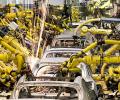
The sharp increase in commodity prices on account of the Russia-Ukraine war has put automakers in a fix. After the frequent price hikes in the current fiscal, manufacturers fear that any more price increases may further dent the already weak demand in certain segments. "We have taken several hikes and cannot immediately do it again. "We will have to closely watch the situation and act accordingly," said an official at an auto firm, declining to be identified. Even for companies like Tata Motors Passenger Vehicles, which has had a strong volume run and a robust order book, passing on the entire costs has been tough.

The 30-share Sensex ended lower by 46 points at 27,842 and the 50-share Nifty slipped 17 points to trade at 8,378.

Brokerages expect Nifty50 firms to post 11.8% growth in net profit in Q1 but sales may decline

Metal prices from copper to aluminum and tin have shot up by about 7-32 per cent in the past three months.
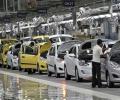
Govt may not announce any new concessions in excise duty
American auto giant Ford is likely to retain a stake and continue supplying engines and some of the components for Jaguar and Land Rover, even after the sale of the two British luxury brands, media reports said in the United Kingdom.

Riding on new launches, Japanese auto major Honda is set for over 62 per cent growth in its sales in India this year at around 1.8 lakh units.

The limited availability of flexible (flex)-fuel vehicles in the Indian market and the slow rollout of ethanol-blended petrol by oil-marketing companies (OMCs) remain major obstacles to achieving widespread use of biofuels in the transportation sector in India. Recently, two Union ministers have emphasised India's biofuel potential, arguing that it has the capacity and potential to lead a transition towards widespread biofuel adoption. Road Transport Minister Nitin Gadkari signalled that this transition is well underway and urged car manufacturers to quickly adapt and introduce new biofuel-run vehicles, lest the government resort to taxing diesel vehicles.

Vehicle sales across categories registered an increase of 5.03 per cent to 16,03,292 units from 15,26,514 units in November 2013.
Nissan currently imports X-Trail and 370Z coupe as completely built unit.

Dealers across brands are slashing prices by Rs 20,000 to over Rs 1 lakh, depending on the car model.
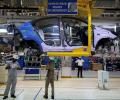
Availability of jobs at India's auto companies has shrunk significantly over the last two years, as the industry goes through one of its worst slowdowns. More than 60 per cent of the total workforce fell by 24 per cent in 2019-20, against 2017-18.

India's economy is showing signs of slowdown, with hi-frequency indicators like industrial output posting subdued growth and automobile sales touching historical lows.

These stocks offer the best combination of maximum 'buy' recommendations from brokerages and share price upside over the next 12 months.


Don't get carried away by the current rally; be picky and take a stock-specific approach.

After the hit of the pandemic, India Inc is now worried about the adverse impact of inflation and higher commodity prices on their revenues and margins. The inflation scare is the strongest among manufacturers of consumer goods such as automobiles, consumer durables, and fast-moving capital goods (FMCG). Companies across sectors fear they will not be able to pass on the hike in input costs to their consumers due to weak demand, which, in turn, would lead to a hit on margins and profitability in the forthcoming quarters.

Union Minister Nitin Gadkari on Monday said American electric car major Tesla is set to start its operations in India next year and would also look at setting up of a manufacturing unit based on demand. The Road, Transport and Highways minister has been pushing for green fuel and electric vehicles for cutting India's huge Rs 8 lakh crore crude imports. Tesla Inc. co-founder and chief executive Elon Musk had in October said the company will enter the Indian market in 2021.
Budget proposal on CKD tax jolts Audi, Harley-Davidson plans.

'If individual stocks start falling 25% to 30% or more, then I doubt how many of them will be able to withstand that (kind of selloff). That is when you'll see panic coming in.'

India's largest two-wheeler maker by volume - Hero MotoCorp (Hero) - posted a better-than-expected operating performance in the January-March (fourth quarter, or Q4) quarter of 2022-23 (FY23). Riding on higher average selling prices which were up 5 per cent year-on-year (YoY) and volume growth of 7 per cent, the company registered a 12 per cent growth in revenue to Rs 8,306 crore. The company sold 127,000 units in the quarter, largely driven by domestic sales which were up 11.6 per cent, while exports saw a sharp fall of 57 per cent over the year-ago quarter.
It will overtake Brazil, Germany and Japan.

India's incumbent two-wheeler players, led by TVS Motors, are flexing their muscles, having crossed the registration of 10,000 electric two-wheelers for the first time in November this year, according to data from Vahan, the website of the ministry of road transport and highways. The two key incumbent players, TVS Motors and Bajaj Auto, now account for around 15 per cent share of registrations in the month of November. The number will only go up with Hero MotoCorp now joining the bandwagon with its Vida range of electric scooters.

The domestic equity market, which is on a record-breaking spree, will focus on macroeconomic data announcements, movement in global stocks and the US Fed minutes to get further direction, analysts said. Trading activity of Foreign Institutional Investors (FIIs) will also innfluence investors.From the domestic macroeconomic front, Purchasing Managers' Index (PMI) data for the manufacturing sector will be released on Monday, and that o,f the services sector on Wednesday. Investors, this week, will keenly watch major global market events, icluding the outcome of the Federal Open Market Committee (FOMC) minutes, scheduled to be out on Wednesday.

While retail sales at dealerships have suffered the full impact of demonetisation, the growth in wholesale volumes comes as dealers had relatively lower inventory after Diwali in October.

Tata Motors on Wednesday launched its Tiago EV with introductory prices for first 10,000 customers ranging between Rs 8.49-11.79 lakh

10 non-bank and non-finance stocks from the BSE500 Index universe that offer an optimal blend of low valuation, reasonably robust revenue and earnings growth in recent quarters, a strong balance sheet, and most importantly, positive cash flow from their operations.

The RBI on Thursday lowered the benchmark repurchase rate to 7.75 per cent from 8 per cent, the first reduction since May 2013.

The compact segment where Sonet will be launched is crowded with the Maruti Vitara and Brezza, which top the sales' list, and a bevy of models from Mahindra & Mahindra apart from Hyundai's offering. But volumes in this are slightly higher than those in the mid-segment, making it attractive, says Surajeet Das Gupta.
A drive through a long endless dark tunnel best describes the journey of India's auto sector in 2013, during which the industry witnessed record spell of decline in sales, vehicle recalls and strikes.

The companies' combined net profit declined by 10.1 per cent y-o-y during June '19 quarter against 26.2 per cent y-o-y growth a year ago.

Leading microchip providers Qualcomm and Intel say the chip shortage might last anything between four months to a year, perhaps even two years, depending on the various product categories - mobile devices, ICE, electric vehicles, appliances, data centres. Prakash Mallya, MD, Intel India and vice president, sales and marketing and communications group, said the spike in demand was huge, and cut across segments from PCs, phones, appliances and auto leading to the shortage.

Increase in taxes on luxury cars will not have any effect on the demand

Auto loan costs remain stubbornly high.

Overnight, the Wall Street closed on a flatter note.

Maruti Suzuki, Hyundai and Mahindra failed to register significant growth.
 © 2026 Rediff.com - Advertise with us - Disclaimer - Privacy Policy - Sitemap - Feedback - About us - Terms of use - Grievances